|
|
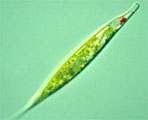
Microalgae are photosynthetic microorganisms responsible for about half of the total global carbon dioxide fixation and thus play a pivotal role as primary producers in the world’s ecosystems. The estimated total number of algal species may exceed one million, a potentially unlimited and largely untapped source of biological diversity to be exploited for basic research in the biosciences and for applications in bio- and environmental technologies. |
 |
Our research aims to enhance knowledge about microalgae to address fundamental questions about their structure, function, origin and evolution, as well as their use to the benefit of humankind. Current emphasis of our research is in three areas:
- Biodiversity, Phylogeny, Systematics, and Evolution of microalgae and their photosynthetic organelles.
- Use of microalgae in bio-, and environmental technologies using our cell immobilization technique, the Twin-Layer System.
- Molecular Cell Biology of flagellate algae.
I have been studying the life of algae for more than 40 years. During this time numerous students and Post-Docs were trained to become independent scientists. And the legacy continues…. |
| |
Michael Melkonian
March 2013
|
| |
|
Words of Wisdom
" Judging scientists by the size of their portfolio is equivalent to judging art by how much money was spent on paint and brushes, rather than the quality of the paintings."
John P. A. Ioannidis (Stanford University)
Nature 477, September 29, 2011, p 531 |
|